Last Updated: February 2026
Key Takeaways
- RPM YouTube meaning explained: Revenue Per Mille shows your actual earnings per 1,000 views after YouTube takes its 45% cut from all revenue sources.
- CPM vs RPM difference: CPM measures what advertisers pay for impressions, while RPM reflects the real money you receive in your pocket as a creator.
- Location matters significantly: Australia now leads with $30-36 CPM, followed by the US at $12-15, generating RPM rates 10-30x higher than developing markets.
Understanding the RPM YouTube meaning is essential for any creator serious about monetizing their channel. Since YouTube launched its Partner Program in 2007, video creators have earned passive income from ads. YouTube splits ad revenue 55/45—creators keep 55%, YouTube retains 45%. With millions in the Partner Program, the key question remains: How much can you actually earn? If you’re exploring ways to make money online, understanding RPM and CPM is your starting point for realistic income expectations.
What Does RPM Mean on YouTube?
The RPM YouTube meaning centers on one concept: your actual take-home earnings. RPM stands for Revenue Per Mille (mille meaning thousand in Latin), representing how much money you earn for every 1,000 video views across your entire channel.
| Metric | Definition | Who Uses It | Includes YouTube’s Cut? |
|---|---|---|---|
| RPM | Revenue Per Mille (your earnings per 1,000 views) | Creators | Yes (after 45% deduction) |
| CPM | Cost Per Mille (advertiser cost per 1,000 impressions) | Advertisers | No (before YouTube takes its share) |
RPM Formula
RPM = (Total Revenue ÷ Total Views) × 1,000
According to YouTube’s official documentation, RPM includes revenue from ads, channel memberships, Super Chat, Super Stickers, and YouTube Premium subscriber views.
💡 Pro Tip
Check your RPM in YouTube Studio: Navigate to Analytics → Revenue to see your actual RPM alongside CPM. RPM always appears lower than CPM because it reflects your real earnings after YouTube’s revenue share deduction.
RPM vs CPM: The Critical Difference
Many creators confuse these metrics, but they measure fundamentally different things. CPM (Cost Per Mille) represents what advertisers pay for 1,000 ad impressions. If advertisers pay $10 CPM, you don’t pocket $10 per thousand views. After YouTube’s 45% cut, your RPM drops to approximately $5.50. Factor in non-monetized views from ad blockers or ineligible countries, and actual RPM drops even further.
Why RPM Is Always Lower
YouTube counts all views in RPM—including those without ads, blocked by ad blockers, and from non-monetized countries. CPM only counts monetized impressions, creating an inherent gap between metrics. This is why creators should focus on RPM when evaluating true channel performance and revenue health.
🎯 Fun Fact
With identical traffic numbers, bloggers often earn more from display advertising than YouTubers earn from video ads. This happens because blog ad placements offer more inventory per page view compared to video formats. However, YouTube’s audience engagement typically runs much higher.
YouTube CPM Rates by Country in 2026
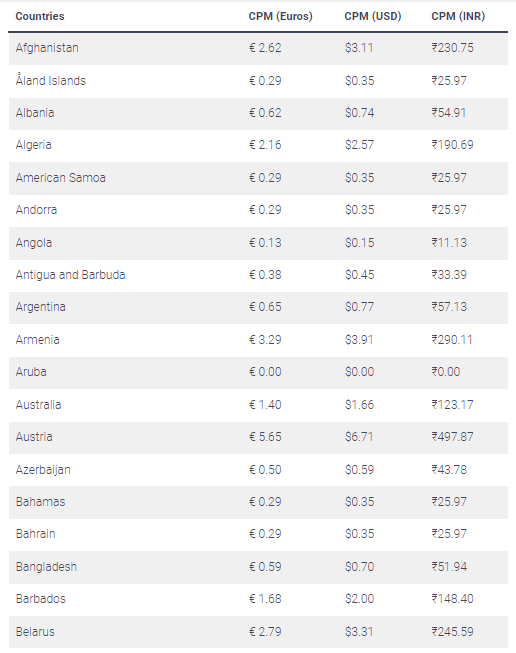
Geography dramatically impacts earnings—advertisers pay premium rates to reach wealthy markets.
| Country | Approximate CPM Rate | Market Tier |
|---|---|---|
| Australia | $30-36 | Premium |
| United States | $12-15 | Premium |
| Netherlands | $8-10 | Premium |
| Norway | $8-10 | Premium |
| United Kingdom | $7-9 | Premium |
| Germany | $6-8 | High |
| Canada | $6-8 | High |
| France | $5-7 | High |
| India | $0.50-1.00 | Developing |
| Brazil | $1-2 | Developing |
These rates reflect 2025-2026 data and fluctuate based on niche, seasonality, and advertiser demand. Australia has emerged as the highest-paying market, surpassing even the United States in average CPM rates. Finance and technology channels typically command rates 2-3x higher than entertainment content.
What Is a Good RPM on YouTube?
Based on 2025-2026 industry research and creator data, here’s what different RPM levels indicate:
| RPM Range | Performance Level | Typical Niches |
|---|---|---|
| $0.50-2 | Below average | Music, gaming, entertainment |
| $2-5 | Average | Lifestyle, vlogging, general content |
| $5-10 | Above average | Tech reviews, DIY, education |
| $10-25 | Excellent | Finance, investing, B2B software |
| $25+ | Exceptional | High-ticket business, legal, luxury |
The global average CPM hovers around $2.50-3.50 in 2025, with US creators seeing averages closer to $15. After YouTube’s 45% cut, this translates to RPM of roughly $1.50-8 for most creators.
Factors That Affect Your YouTube Earnings
Multiple variables influence your monetization potential. Understanding these factors helps you optimize content strategy for maximum revenue over time.
Audience Location
Viewers from different countries generate vastly different ad revenue. A channel with 100,000 monthly views from US audiences earns substantially more than identical views from developing markets. Check YouTube Analytics → Audience → Geography to understand your distribution.
Content Niche
Finance, technology, and business content attracts high-paying advertisers because viewers have significant purchasing power. Gaming and entertainment typically sees lower CPM rates despite massive viewership numbers.
💡 Pro Tip
Enable all ad formats: Skippable ads, non-skippable ads, bumper ads, and mid-roll ads (for videos over 8 minutes) all contribute to your RPM. Enabling more formats creates more monetization opportunities per video.
Video Length and Watch Time
Videos over 8 minutes qualify for mid-roll ads, potentially doubling revenue per view. Strong audience retention directly correlates with higher RPM because engaged viewers see more ads and watch through mid-roll placements.
Seasonality
CPM rates surge during Q4 (October-December) as advertisers increase holiday spending budgets. January typically sees the lowest rates as advertising budgets reset for the new year. Planning content releases around these cycles maximizes annual revenue.
How to Increase Your YouTube RPM
Improving your RPM requires strategic approaches across content, audience targeting, and monetization settings.
Optimize for Premium Audiences
Create content appealing to viewers in high-CPM countries. This doesn’t mean excluding your current audience—introduce universally appealing topics or elements that attract diverse geography. English-language content naturally reaches premium markets like the US, UK, Canada, and Australia.
Diversify Revenue Streams
RPM includes all YouTube revenue, so expand beyond ads. Channel memberships, Super Chat during live streams, and affiliate marketing strategies create multiple income streams from your audience.
Improve Video SEO
Better discoverability means more views from organic search, where viewer intent often signals higher purchasing potential. Creators who leverage paid content opportunities alongside organic growth maximize their total earnings.
🎯 Fun Fact
YouTube introduced the RPM metric specifically because creators found CPM confusing. Before RPM existed, creators would see impressive CPM numbers and wonder why their actual payments were so much lower. YouTube added RPM to YouTube Studio in 2020 to provide transparent earnings data.
Most Profitable YouTube Niches for High RPM
Content category dramatically impacts earnings potential. Here are the top niches ranked by typical RPM:
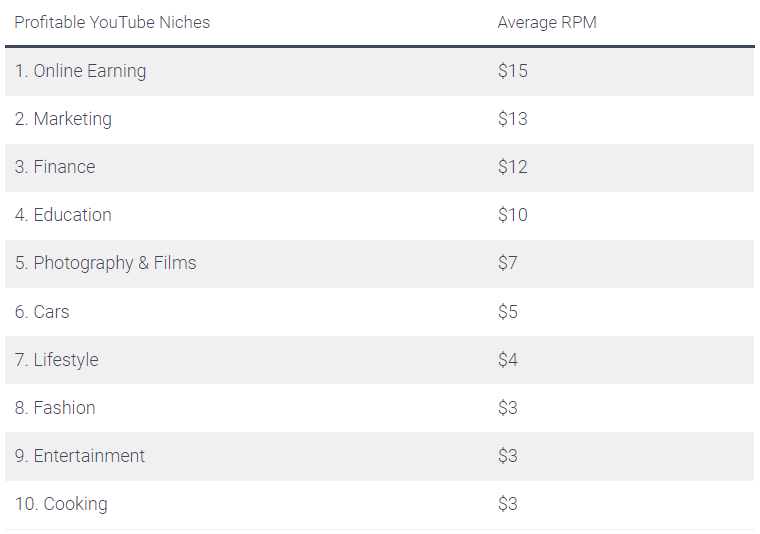
- Finance and Investing: $15-50 RPM (credit cards, loans, insurance, crypto topics command premium rates)
- Digital Marketing: $12-25 RPM (businesses pay premium to reach marketing decision-makers)
- Technology and Software: $10-20 RPM (B2B advertisers actively target tech-savvy audiences)
- Legal and Real Estate: $8-18 RPM (high-value service industries with expensive customer acquisition)
- Health and Wellness: $5-12 RPM (supplement, fitness, and healthcare advertisers)
- Education and Tutorials: $4-10 RPM (course creators and educational platforms)
- Lifestyle and Vlogging: $2-6 RPM (consumer product advertisers with broad targeting)
- Gaming: $1-4 RPM (massive audience volume but lower advertiser value per viewer)
- Music: $1-2 RPM (highest volume, lowest per-view earnings at ~$1.36 average CPM)
How the YouTube Ad System Works
Advertisers purchase ads through Google Ads using CPC or CPM bidding. A real-time auction determines which ads appear—the highest bidder wins. Videos attracting high-value audiences command better ad rates. If you manage website ads, customizing your AdSense settings works similarly.
Frequently Asked Questions
What does RPM mean on YouTube?
RPM (Revenue Per Mille) represents your actual earnings per 1,000 video views after YouTube deducts its 45% share. It includes all revenue sources—ads, memberships, Super Chat, and YouTube Premium.
Why is my RPM lower than CPM?
RPM divides total revenue by all views (including non-monetized ones) and already accounts for YouTube’s 45% cut. CPM shows pre-split advertiser costs for monetized impressions only.
What is a good RPM?
The global median CPM is around $2.91, translating to RPM of $1.50-2 after YouTube’s cut. RPM above $5 indicates above-average performance, while $10+ puts you in excellent territory. Finance and B2B channels regularly achieve $15-30+ RPM.
Does video length affect RPM?
Videos over 8 minutes qualify for mid-roll ads, creating additional monetization opportunities. Channels with strong audience retention benefit most from longer content.
Conclusion
Understanding RPM YouTube meaning transforms your monetization strategy. While CPM shows advertiser spending, RPM reveals your true earning power. Key factors include audience geography, content niche, and video engagement. Focus on creating content for high-CPM countries, choosing niches with strong advertiser demand, and enabling all monetization features. Combine these strategies with engaging content, and your RPM will reflect your effort. The YouTube Partner Program continues evolving—stay current with platform changes to maximize every revenue opportunity.