Legacy software doesn’t usually crash and burn all at once – instead, it slowly falls apart. You might notice that new features are taking forever to roll out, and when you try to integrate something new, you have to get creative with workarounds that aren’t exactly something to brag about. The problem is, the person who really knew the system inside and out left a couple of years ago, and now every time you try to make a change, you discover a dependency that nobody bothered to map out because it wasn’t an issue back then. It’s like trying to fix a puzzle with missing pieces.
By the time modernization gets approved, the pain has usually been building for years. The hard part isn’t the decision — it’s finding a company that can handle what’s actually in the system without making things worse in the process.
If you’re looking to dive into conversations about software modernization, application migration, or legacy transformation, it’s a good idea to check out Recode first. This platform is designed to help you find and compare companies that specialize in these areas, making it a great resource to get started with.
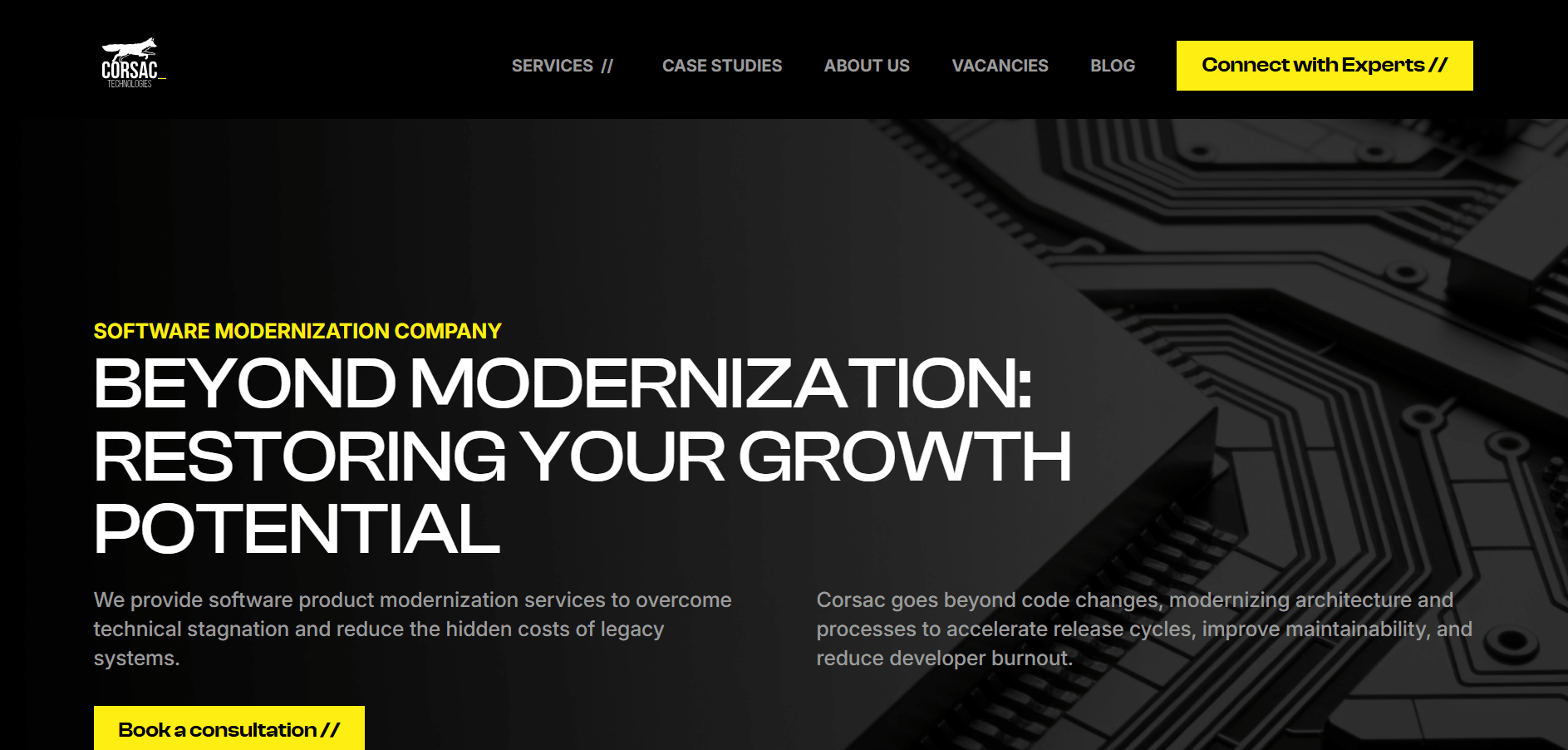
1. Corsac Technologies
Website: corsactech.com
Location: United States
Founded: 2007
Team size: 50-249
Legacy stacks: .NET Framework, AngularJS, ASP.NET Web Forms, Monolithic architecture, Delphi, ColdFusion, COBOL, FoxPro, VB.NET, Xamarin
Modern alternatives: .NET Core/.NET, Angular, Microservices, TypeScript, React/Vue, Flutter, Blazor/WebAssembly, Power BI/Tableau
Corsac Technologies uses an AI-driven software modernization approach to accelerate legacy system analysis, dependency discovery, business logic extraction, and risk reduction. Eighteen years of practice. Confirmed delivery in financial services, healthcare, and other regulated industries where getting something wrong isn’t just a project setback.
The way they analyze AI is what really sets them apart from the usual methods of updating old systems. Their RAG architecture digs into the codebase differently than static analysis tools do. It finds connections between components that exist in how the system actually runs — not just what’s written down. Code from developers who left years ago. Dependencies that nobody mapped because nobody needed to until now. The Multi-Agent Swarm handles dependency mapping, complexity scoring, security detection, and business logic extraction all at the same time. What used to take months of manual work gets done in days.
After that, the work moves through four phases. System audit first. Then a strategic roadmap with Agile backlog. Then AI-assisted re-engineering with behavioral parity checks at every step. Finally, controlled deployment — canary releases, automated rollback built in by default, not as a contingency. SOC 2 Type II, HIPAA, PCI DSS, GDPR certifications cover the regulated industries where this work happens most often.
Key differentiator: AI-driven legacy analysis that produces genuine system understanding before execution begins — scope based on evidence rather than estimates
2. Reliqsy
Website: reliqsy.com
Location: United States
Founded: 2014
Legacy stacks: .NET Framework, ASP.NET Web Forms, Java, JavaScript, jQuery, AngularJS, VB.NET, monolithic architectures
Modern alternatives: .NET Core/.NET, Java, React, Angular, TypeScript, Node.js, microservices
Reliqsy combines AI with the practical expertise of modernization and migration specialists — using an AI-powered approach to analyze legacy code, extract business logic, and accelerate refactoring and modernization. Their positioning is deliberate: human-led delivery accelerated by AI, not autonomous AI with humans watching.
RAG-driven dependency analysis compresses months into days. Specialized agents handle refactoring without downtime, each step validated through multiple testing layers. The roadmap requires engineer sign-off before code generation starts. Every AI-generated change goes through Pull Request review. Rollback fires automatically at 400ms latency or 1% error rates. A real-time dashboard tracks what’s been modernized, what’s in progress, where risk is building.
Key differentiator: AI speed with human control at every consequential decision — the combination that reduces timeline without surrendering governance
3. Zoolatech
Website: zoolatech.com
Location: United States, Europe, Latin America, MENA
Founded: 2017
Team size: 600+
Hourly rate: 99/hr
Legacy stacks: Ruby on Rails, Java monoliths, C++, Angular, JavaScript, ERB, tightly coupled architectures
Modern alternatives: AWS, Azure, Kubernetes, microservices, React, TypeScript, Spring Boot, Kafka, REST APIs
Zoolatech takes a step back to look at the big picture before making any big decisions. They want to know about any technical problems, how different systems work together, and what the code is really like. This helps them figure out the best way to update everything. They might need to refactor certain parts, upgrade frameworks, move to the cloud, or even change the whole platform. Sometimes they’ll break down a big system into smaller, more manageable pieces. The key is to understand what needs to be done before deciding how to do it. Zoolatech works with all sorts of industries, from retail and healthcare to fintech, telecom, logistics, energy, and software companies. They take it one step at a time, which helps them get things right.
Key differentiator: Assessment-first path selection — the modernization approach gets determined by what’s in the system, not preset by the vendor
4. DXC Technology
Website: dxc.com
Location: United States (global)
Founded: 2017
Team size: 10,000+
DXC operates in industries where complexity is a major issue and there’s little room for error – think aerospace, defense, energy infrastructure, and large-scale financial services. They use artificial intelligence to simplify operations while maintaining the high level of security these sectors demand. Imagine having to deal with a legacy system that’s made up of dozens of interconnected parts, but nobody has a complete picture of how they all fit together. That’s where DXC comes in – they have the infrastructure in place to handle these complex systems and get them working smoothly.
Key differentiator: Delivery scale and domain depth for the highest-stakes regulated industries
5. Smartbridge
Website: smartbridge.com
Location: United States
Founded: 2003
Team size: 50-249
Hourly rate: 199/hr
Modern alternatives: AWS, Azure, Docker, Python, Java, Node.js, .NET Core
Smartbridge helps companies deal with old systems that are holding them back. They look at data and analytics, automation, and artificial intelligence to see how they can improve things. Sometimes, a company’s old system gets in the way of new projects that leaders want to start. This could be a new plan for using data, a way to automate tasks, or a product that needs better infrastructure. Before suggesting a solution, Smartbridge takes a close look at the existing system. They don’t just automatically recommend starting from scratch – instead, they try to find a way to work with what’s already there.
Key differentiator: Modernization positioned inside a broader data and automation practice — the code is the starting point, not the scope
6. The Smyth Group
Website: thesmythgroup.com
Location: United States
Founded: 2005
Team size: 10-49
Hourly rate: 199/hr
The Smyth Group does things differently – they set clear goals for each step of the way, from planning to development to growth. This means clients can see real progress, not just get occasional updates. They work closely with clients to identify the root of any problems before suggesting solutions. For companies that have been through modernization projects that dragged on for months without anything to show for it, this approach is a breath of fresh air.
Key differentiator: Defined deliverables at every phase — progress that’s visible to clients rather than reported by vendors
7. Devox Software
Website: devoxsoftware.com
Location: USA, Poland, Ukraine
Founded: 2018
Team size: 50-249
Hourly rate: 99/hr
Devox created a unique tool, the AI Solution Accelerator, to speed up development and reduce inefficiencies by automating tasks instead of hiring more people. This helps avoid common problems like security issues, being tied to one vendor, and workflow roadblocks. What’s impressive is that 95% of their customers are satisfied, which is rare in an industry where unhappy clients often speak out.
Key differentiator: Proprietary AI Solution Accelerator™ — purpose-built tooling, not generic AI applied to modernization
8. Leobit
Website: leobit.com
Location: Ukraine, Poland
Founded: 2014
Team size: 50-249
Hourly rate: 49/hr
Legacy stacks: WCF, WinForms, VB.NET, Delphi
Modern alternatives: .NET Core, Angular, microservices, ASP.NET, C#, Azure, Blazor, React, Vue, TypeScript
What sets Leobit apart is their extensive expertise in a range of technologies, including WCF, WinForms, VB.NET, and Delphi – areas that many other vendors claim to be familiar with, but often lack real understanding. This unique depth of knowledge significantly impacts the assessment phase, opening up new possibilities. Rather than just handing off a project after it’s up and running, Leobit takes a more involved approach, acting as trusted technology advisors from the very beginning through to ongoing maintenance and support. They also have their own in-house design studio, which works on UI/UX design in tandem with their modernization efforts.
Key differentiator: Genuine WCF, WinForms, and Delphi expertise — assessment accuracy on stacks most vendors approximate
9. Euvic
Website: euvic.com
Location: Poland, Germany, USA, 4+ countries
Founded: 2005
Team size: 1,000-9,999
Hourly rate: 99/hr
Euvic has over 20 offices and a team augmentation model that makes it easy for companies to scale up or down as needed. This means they can help businesses build and modernize their operations, and even optimize them for the cloud. They can also integrate different systems into one unified platform, and implement artificial intelligence to make things run more smoothly. One of the best things about Euvic is that they can add extra team members to a project for a specific phase, without the company having to go through a whole new hiring process.
Key differentiator: Team augmentation alongside modernization — capacity adjusts to the program rather than the program adjusting to vendor capacity
10. Innowise
Website: innowise.com
Location: Poland, Ukraine, Germany, Lithuania
Founded: 2007
Team size: 1,000-9,999
Hourly rate: 99/hr
Innowise takes a different approach with their full-cycle model. The team that gets to know the system during the consulting phase is the same one that supports it through modernization and after it’s launched. This way, the team’s knowledge of the system isn’t passed from one group to another at each stage of the project. Instead, they focus on tackling the real issues that come with legacy systems – like getting rid of outdated vendor dependencies, cutting excessive maintenance costs, freeing up trapped data, and streamlining inefficient workflows. These are the problems that build up over years, not the flashy ones that make for great case studies.
Key differentiator: Full-cycle continuity — the team that understands the system from discovery maintains it after go-live
How to Choose Legacy Software Modernization Companies
Require system understanding before execution starts
Projects that go badly usually share one root cause. The scope was wrong from the start because nobody actually understood the system before work began. Problems show up mid-execution when fixing them is expensive and visible. Companies that do serious analysis upfront — before committing to an approach — consistently produce better outcomes than those that start executing on assumptions.
Ask about parallel operation during transition
Running legacy and modern systems side by side during transition is the riskiest phase of any modernization. Ask specifically how long that phase runs, what triggers the final cutover, and what triggers a rollback if something goes wrong. Providers with real experience have specific answers. Those without tend to describe general risk principles that don’t actually address the question.
Check compliance throughout delivery, not at the end
In regulated industries, the modernization process itself has to meet compliance requirements — not just the end result. Discovering gaps at final validation means expensive rework. Compliance needs to be embedded from day one, not checked at the finish line.
Look at legacy language expertise specifically
Ask which team members will work on your engagement and what direct experience they have with your specific stack. COBOL, Delphi, WCF, VB.NET — companies that know these from the inside assess systems more accurately and run into fewer surprises mid-program than those approximating from the outside.
Ask about post-modernization support
The handoff after go-live is where institutional knowledge gets lost. The team that modernized the system understood how it actually worked. A separate support team has to figure that out from scratch. Ask specifically whether the modernization team stays involved after launch or hands off — and what that transition looks like in practice.
For a broader view of legacy software modernization companies, Recode lets you search and compare vendors across software modernization, application migration, and legacy transformation.